Quick answer: What happens to the mortgage when you dissolve co-ownership in Spain?
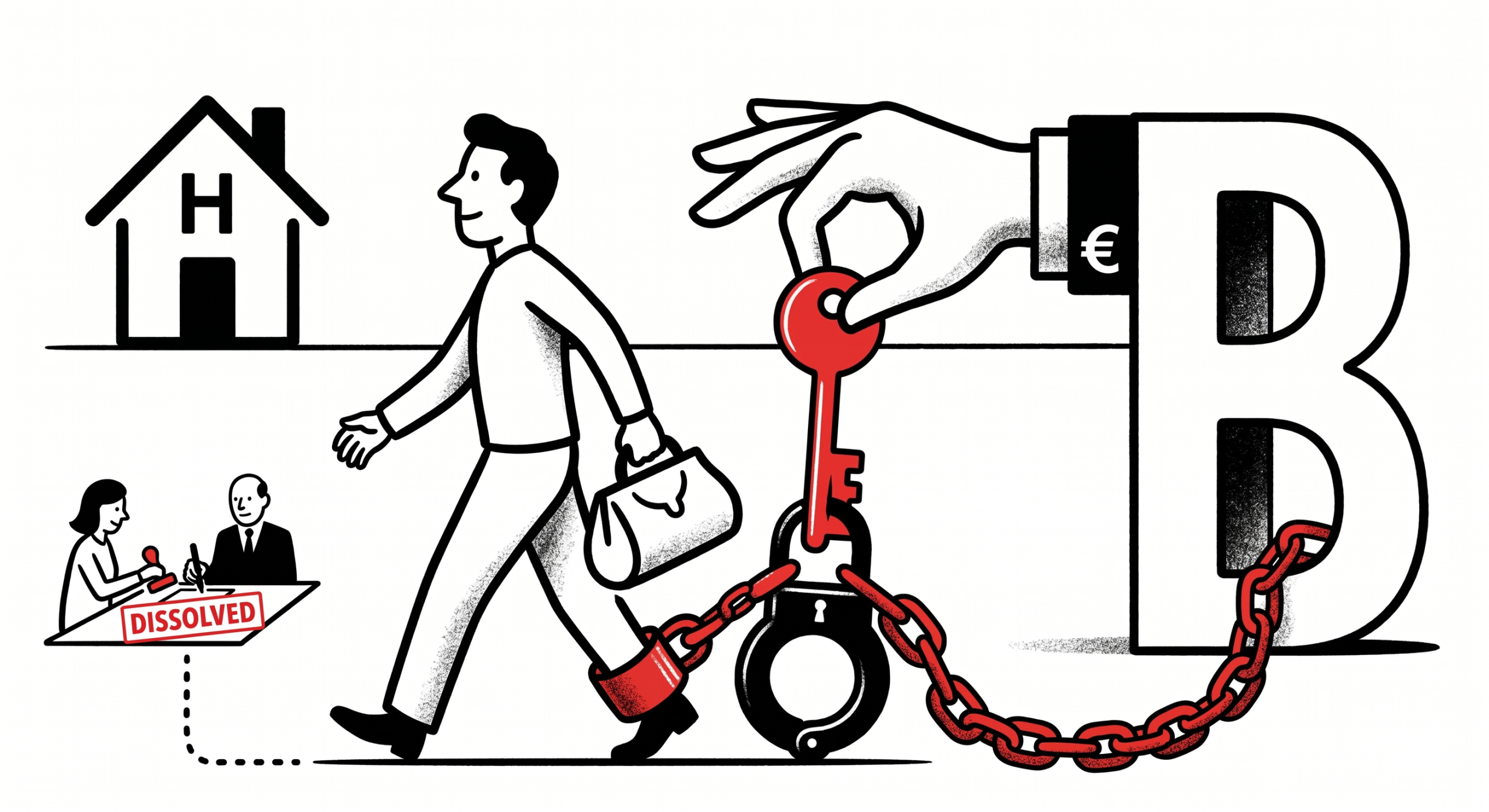
When you dissolve co-ownership (extinción de condominio) on a mortgaged property, the agreement between the co-owners does not release the departing party from the debt. To stop being a debtor with the bank, the bank must explicitly accept that release. Without the bank's approval, the departing co-owner remains on the hook — and on Spain's central credit register — for a property they no longer own.
The dissolution is taxed as a standard co-ownership dissolution, and if the bank signs off on the release, an additional Stamp Duty (Actos Jurídicos Documentados, AJD) charge applies. If you need financing to pay out the departing co-owner, you can extend the existing mortgage or take out a new one.
Contenido de este artículo
ToggleWhat is co-ownership dissolution in Spain?
Extinción de condominio is the legal mechanism by which two or more co-owners of a Spanish property end their shared ownership — one party keeps the property and compensates the other. It is the most tax-efficient way to split a jointly owned property in Spain, and it is the standard solution in separations, divorces, and inheritance situations.
Introduction
Life changes, and sometimes those changes mean untangling a shared mortgage with someone you are no longer with. The decision is made: one of you keeps the property and takes on the mortgage, the other moves on. You sign the co-ownership dissolution at the notary, shake hands (or not), and go your separate ways. End of story?
Not even close.
You have just divorced yourself from the property, but you are still married to the bank. And you probably want out of that marriage as quickly as possible.
Or perhaps there is no mortgage at all — the property was inherited or the existing mortgage is small — and now you need financing to pay out the co-owner who is leaving.
This article covers both scenarios:
- The property already has a mortgage.
- The property has no mortgage and you need one to fund the compensation.
Scenario 1: The property already has a mortgage (divorce and separation cases)
The typical case: a couple bought a property with a mortgage and now wants to dissolve the co-ownership — one person takes 100% of the property and assumes the mortgage.
I signed the dissolution and my ex is taking on the mortgage. Am I free from the bank?
No. The agreement you sign with your ex, however formal — even in a notarial deed — has full legal force between the two of you, but it does not bind the bank unless the bank consents.
Why is our agreement not enough to release me from the debt?
You need to separate two distinct contractual relationships: the one between you and your ex, and the one both of you have with the bank. They are two different contracts.
The effect of the agreement between the parties
Your agreement is a contract with the force of law between the contracting parties. Your ex assumes full responsibility for 100% of the loan repayment.
Why the bank's consent is essential
The original mortgage is a separate contract with the lender. For you to exit that contract, the creditor must consent. Your private agreement with your ex is only binding between the two of you — it has no effect on the bank.
What are the practical consequences if the bank does not release me?
As long as the bank has not accepted your exit from the loan:
- You remain a joint and several debtor: if your ex defaults, the bank will pursue you for 100% of the outstanding debt. You then have a separate claim against your ex, but that is your problem to deal with.
- You will appear on Spain's central credit register (CIRBE): the debt continues to show against your name, which can block you from obtaining new financing.
- Your assets remain exposed for a property you no longer own. It is the financial equivalent of paying for a gym membership you cannot use.
Mortgage novation: the only way to remove yourself from the debt
A novación (novation) modifies the original loan and formally removes one debtor with the bank's acceptance. This involves negotiation and a fresh solvency assessment by the bank.
How must the bank give its consent?
The bank's acceptance of the release of a co-debtor is usually given expressly, in a notarial deed:
- In a deed of mortgage novation and debtor release, where the bank's representative appears alongside the debtors and gives their consent.
- Or in the co-ownership dissolution deed itself, where the bank's representative also appears and consents.
The bank can also give its consent in any form, at any time, as long as the underlying agreement between the debtors is still in force.
Express vs. tacit subrogation
Spanish law distinguishes between express and tacit subrogation. The latter arises from facts occurring at the same time as, or after, the agreement between the debtor and the assuming party — facts that confirm the bank's knowledge and acceptance of the arrangement.
The tax bill: which taxes are triggered by the debt?
Co-ownership dissolution on a mortgaged property is taxed, as a baseline, like any other dissolution (Stamp Duty on the share acquired), but the presence of the mortgage debt triggers additional risks you need to know about:
Stamp Duty (AJD): The main tax. If the bank signs the debtor release, an additional taxable event arises. The key battle with the tax authorities is the taxable base: is Stamp Duty payable on 100% of the mortgage liability, or only on the departing co-owner's share?
Gift Tax (ISD): Watch out here. If you keep the property and the debt you assume is less than the value of the share you receive — without compensating for that difference — the Spanish Tax Authority (Hacienda) could argue that your ex has effectively made you a gift. That is taxed as a donation, and it can be very expensive if you are no longer spouses or registered domestic partners.
Income tax and municipal capital gains tax (Plusvalía): Rather than extend this article, if you want to see the full impact of these taxes alongside a comparison with a sale or a pure donation, see my General Tax Map for Co-Ownership Dissolution.
The netting mistake: If your property is worth €300,000 and the outstanding mortgage is €100,000, the share you are acquiring is worth €150,000 (50% of the gross value). Do not make the mistake of deducting the debt before calculating the excess allocation. You are dissolving co-ownership over the bricks, not over the net profit. This is the opposite of what happens in a dissolution of community property (gananciales), where the debt is deducted from the property value to calculate the split.
For Hacienda, taking on the other person's mortgage counts as a cash payment.
Note on community property (gananciales): If your matrimonial regime is community property and both the property and the debt are community assets, the netting issue does not apply — and you have a tax advantage: the allocation of the property is exempt from Stamp Duty under Art. 45.I.B.3 of the Spanish Transfer Tax Act. The tax saving is significant, and the balance of the split is always calculated on the net value.
Scenario 2: You keep the property, you take on the debt — but you need cash to pay out your co-owner
You have agreed to take 100% of the property. As part of the deal, you take on the other person's share of the mortgage. The problem: because the property is worth more today than when you bought it, on top of absorbing the mortgage you also owe your co-owner a cash payment — say, €30,000. And when you check your bank account, that money is not there.
How do you fund that compensation without breaking yourself in the process? You have two main options and one high-risk escape route.
1. Mortgage extension via novation (the ideal option)
The most logical route is to sit down with your bank and ask for two things at once: remove your co-owner from the loan and extend the capital so you can pay them out. You are not changing lender — you are renegotiating the terms of your existing contract to reflect your new reality as sole owner.
What will the bank ask for?
You will be facing the mortgage alone, with a higher monthly payment, so the bank will put your solvency under the microscope:
- Real repayment capacity: you will need to demonstrate that the new, larger payment does not exceed 30% of your net monthly income.
- Stability: a solid credit history and demonstrable employment, business, or professional stability.
What are the costs?
- Property valuation: the bank will want an up-to-date valuation before agreeing to the extension. Expect to pay between €250 and €500.
- Novation fee: if stipulated in your original deed, this typically ranges from 0% to 1% of the outstanding balance.
2. Cancellation and new mortgage
What if your current bank flatly refuses to extend the capital or to remove your co-owner? Then you look elsewhere.
The solution here is to apply for a new mortgage with a different lender. The mechanics: the new bank lends you the full amount; part of it cancels the original joint mortgage, and the remainder funds the compensation payment to your co-owner. This is effective — it definitively severs the other person's involvement — but it is typically more expensive in the short term. You will need to cover the costs of cancelling the existing mortgage (early repayment fees, notary and land registry costs) and opening a new one from scratch. The Stamp Duty on the new mortgage itself is paid by the lending institution.
3. The escape route: private debt assumption and deferred payment
If the timing is bad, or interest rates are high, and no bank will lend to you alone, there is a third path — but it carries real risk.
Remember: ownership of the property and liability for the mortgage do not have to coincide. If your co-owner agrees (which is the difficult part), you can sign the co-ownership dissolution at the notary, transferring 100% of the property to you, without touching the mortgage with the bank. In the same deed, you commit to paying 100% of the mortgage instalments going forward. And for the €30,000 you owe your co-owner, you can agree on a deferred or instalment payment arrangement.
Be clear about the risk: the bank does not know about any of this. As far as the bank is concerned, your co-owner remains a fully liable debtor. If you stop paying the mortgage, the bank will pursue either of you for the full debt. Your co-owner could face enforcement proceedings and would then have to sue you for damages based on your private agreement. This is a viable option to avoid deadlock, but it requires complete mutual trust.
Conclusion
Signing a co-ownership dissolution when a mortgage is involved is one of the most legally treacherous property transactions in Spain. A handshake at the notary is not enough — the bank must consent.
And remember: if you take on a property worth €300,000 and the mortgage is the same, your Stamp Duty base is not zero. Leave the netting for the community property dissolution. In a standard co-ownership dissolution, you pay tax on €150,000.
If you are in this situation and want to avoid a costly mistake — whether with the bank, with Hacienda, or with your co-owner — do not rely on a chatbot for legal advice. Book a professional consultation to map out your options before you sign anything.
No. Your agreement is fully binding between the two of you, but it does not affect the bank. For the bank to release you from the debt, it must give its explicit consent
You remain a joint and several debtor, you stay on Spain’s central credit register (CIRBE), and your assets are exposed for a property you no longer own.
Stamp Duty (AJD) applies as a baseline, with a potential additional charge if the bank signs the debtor release. Gift Tax (ISD) may also apply if the value transferred is not fully compensated.
Three options: novation of the existing mortgage (extend the capital with your current bank); cancel the mortgage and take out a new one with a different lender; or, as a last resort, a private debt assumption agreement with deferred payment — though this carries significant risk for your co-owner.